Monday, April 25, 2016

i was ...

i was Excited to start fresh. a freshman with a desire to see it all, conquer it all, in the expansive, labyrinthine walls of my crowded high school.
i was Anxious when work became heavy, friendships became murky, but flourished in the bustling schedule provided by the studious mix of academia and extracurricular.
i was Conflicted as my first seemingly difficult year came to an end and two paths diverged before me and logic alone would not provide an answer.
i was Happy because though my future held scholarly separation from current friends, summer was mine, ours, anyone's to take.
i was Conflicted: retrospectively it was too much but i felt a monstrous motivation refusing to let go. sleepless weeks, tear fueled drives, constant self loathing: why couldn't i do better? 
i was Anxious without sleep yet refused to let myself back down. school over all. icy perfection is not real, not healthy but it ran through my blue veins, my drug.
i was Excited to see lights, to reach my final chapter in a seemingly endless book and see the changing, ebbing tides that accompanied this year. there is hope, help, and happiness in struggle. 

i am Still Figuring It Out. 


Monday, April 11, 2016

xoxo walt whitman

My interpretations of Whitman's somewhat legible handwriting, after reading some of his journal:

"Welcome the stars - welcome the trial - let the waves / Why now I shall see what the old ship is made of / Any body can sail a .. fair wind ... / Ship of Libertad / Blow mad winds! / Rage boil seas your wide ... waves, / Crash away - / Tug at the planks - them groan - fall (full?) around, black clouds - clouds of death / Come now we will see what stuff you are made of Ship of Libertad / Let thus ..."

"I want to see what ? before I die, / I welcome this menace - I welcome thee with joy"

"Ship of the world - Ship of Humanity - Ship of the ages ? (Ship that circlest the world) Ship of the hope of the world - Ship of Promise" followed with illustrations of men's profiles, with variations of hats and features, followed by a sketch of a harp (?) 

"Here stood Washington / The last war" followed with illustration of Washinton-esque skeleton, with a skewered heart- this seems like a commentary by Whitman on the Civil war threatening the bonds of the States of the time

- From my observations of Whitman's journal I was only able to interpret some of the lines. I really enjoy his work in Leaves of Grass, and this is just further proof that his work is truly significant, even in its roughest form. His lines about ships seem to mirror his ideas about versatility and strength in adversity; he suggests that one of the two men in the conversation is suggesting that the "Ship of Libertad," most likely the United States, should welcome the struggle to strengthen itself in the end. It seems a beautiful image, and a hopeful tone is there despite the topic. He continues with the theme of ships, testing various names of the ship, all with diction that has relatively positive connotations; this seems like brainstorming, maybe still in reference to the United States. The last couple pages in the file are about George Washington and have a darker mood; the illustration of the skeleton and sword-skewered heart is in contrast to the earlier illustrations of people, hats, and harps. In my opinion, this seems to reflect Whitman's disappointment in conflict and maybe he is criticizing the United States for slipping back to such conflict after not listening to the founder's advice. 
- Looking at what Whitman actually wrote, I felt okay with my original observations from the journal. There were significant parts of the journal that I was not able to read which had been deciphered, including the opening pages. I was especially interested by his page on religion which did not seem to belong in this presidential dialogue, but which alluded to another part of his work and himself. Heading in to the work on the conversation with Lincoln, I felt that I had been headed in the right direction with my observations; Whitman respected Lincoln but was conflicted about the war on the horizon. Whitman reveals that while he desires a more accepting nation, a stronger bonded nation, he detests violence or conflict and the damage it yields to the people when using later metaphor to a ship. He compares Lincoln to the captain and as I assumed, the United States is the Ship of Libertad, the Spanish word for liberty. Something I had not thought about was the global ramifications of these events but this is something explored here too in the various names of the ship.

http://weknowmemes.com/generator/uploads/generated/g1388517613946204393.jpg


Sunday, March 20, 2016

America! Dreams! HEck yeah!

http://www.relatably.com/m/img/great-gatsby-meme-creator/gatsby_meme3.jpg
The "American Dream" is to be able to come to the United States as you are, to find new opportunity, work hard and achieve your goals in an independent manner. Many imagine the end goal of such a dream to be wealth. However, I believe this term is a bit more ambiguous. The word wealth, to me, draws ideas of excess, usually of money or luxury goods. One can also have a wealth of luck, of happiness, of friends, of puppies, or of anything. I desire a wealth of knowledge and a poignant attitude of persistent acceptance.

The general American attitude towards wealth and poverty varies greatly depending on who you ask. The wealth and poverty of the "American Dream" is separated by a simple series of well-harnessed opportunities and perseverance; wealth can be attained from poverty. The modern consensus seems to drift from this slightly, with the idea that economic status is becoming more static, that the core of the American Dream is not as true. I think that the view of economic status as an unhindered journey on a ladder is more of a non-American view of American economics. Majority of Americans believe that wealth is something to aspire to; money is power, money can reduce stress and solve problems. The idea of monetary wealth is associated not just with being rich, but also with being happy. This greatly contrasts the associations made with the impoverished community; the American does not idealize poverty, and some believe that impoverished individuals "choose" this, for lack of trying. Others view those in poverty with pity, some with understanding, especially if they have been close to the issue themselves.  

Personally I desire happiness, though the monetary equivalence is different for each individual. I do not value monetary wealth as highly as some; of course, making money would be nice and would alleviate stress, but for me it is not an end goal. My own goals circulate my aspirations for my future career, which, mirroring the message that passion overtakes salary, were not established in the hopes of financial prosperity. I aim to be an engineer, though I don't know of what specialty, so that I can contribute my own knowledge to the solutions of global issues like inefficient diagnostic technology, unsustainable agriculture, human reliance on fossil fuels, and the lack of global social equality or justice. My personal attitude towards wealth and poverty helped me to establish my goals, to an extent; I believe that all individuals deserve access to healthcare, preventative, diagnostic, and treatment-based, despite economic status. It shouldn't be an unimaginable burden on a family or individual to protect their right to health. I believe that well-being should not be limited to a single class and my personal attitudes are based on my experience working with healthcare professionals, and my upbringing by a compassionate teacher-mother. 

Sunday, February 21, 2016

EYE OH SEE

My IOC recording would not upload, sorry guys. I know you were all really excited to hear what sounds like a small child speaking random words about Macbeth in a desperate, nervous attempt at analysis.  
MY PASSAGE: characterizing Mac(bae)th and Banqu(yo) 
*********************************************************************************
That trusted home
Might yet enkindle you unto the crown,
Besides the thane of Cawdor. But 'tis strange:
And oftentimes, to win us to our harm,
The instruments of darkness tell us truths,
Win us with honest trifles, to betray's
In deepest consequence.
Cousins, a word, I pray you.
[Aside] Two truths are told,
As happy prologues to the swelling act
Of the imperial theme.--I thank you, gentlemen.
Aside
Cannot be ill, cannot be good: if ill,
Why hath it given me earnest of success,
Commencing in a truth? I am thane of Cawdor:
If good, why do I yield to that suggestion
Whose horrid image doth unfix my hair
And make my seated heart knock at my ribs,
Against the use of nature? Present fears
Are less than horrible imaginings:
My thought, whose murder yet is but fantastical,
Shakes so my single state of man that function
Is smother'd in surmise, and nothing is
But what is not.
Look, how our partner's rapt.
[Aside] If chance will have me king, why, chance may crown me,
Without my stir.
New horrors come upon him,
Like our strange garments, cleave not to their mould
But with the aid of use.
[Aside] Come what come may,
Time and the hour runs through the roughest day.
Worthy Macbeth, we stay upon your leisure.
Give me your favour: my dull brain was wrought
With things forgotten. Kind gentlemen, your pains
Are register'd where every day I turn
The leaf to read them. Let us toward the king.
Think upon what hath chanced, and, at more time,
The interim having weigh'd it, let us speak
Our free hearts each to other.
Very gladly.
Till then, enough. Come, friends.
 *********************************************************************************
Criterion A: Knowledge and understanding of the text or extract
I give myself a 5. I showed adequate knowledge of the text as a whole by providing background information about Macbeth and putting the passage in context, and supported most comments with at least some reference to the text, whether plot or specific quote.

Criterion B: Understanding of the use and effects of literary features 
I give myself a 5. I used examples of stylistic features and literary devices in my commentary and provided evidence of some understanding of their effect/purpose.

Criterion C: Organization
I give myself a 2. I attempted to stay on track with what I had prepared but my structure was not always well organized/was sometimes repetitive.

Criterion D: Language
I give myself a 3. I used proper literary language, but overall it was an informal commentary.  


Sunday, February 7, 2016

Judging Book Covers?

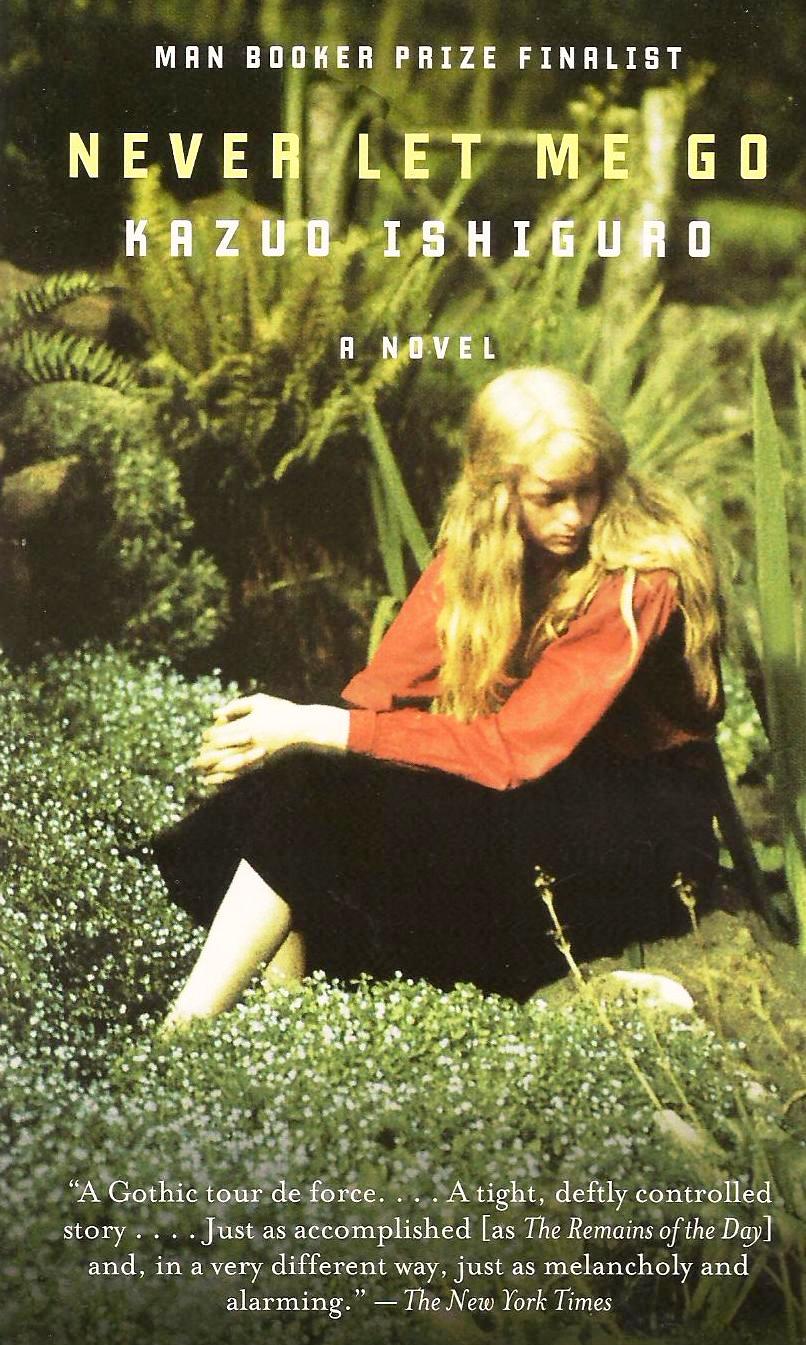
  The variety of covers that are available for this single novel is impressive, but begs the question of why? If each of these is the same text, why do they have a different cover illustration? 

The four pictured here for Never Let Me Go all create a similar resulting overall mood but in different ways and with unique undertones and styles. The meadow at first appears light, lush, and natural, but the heavily saturated shadows paired with the expression of the girl makes it fantastical or uncanny. The girl's light, long hair and pale skin contrasts the figure in the next cover illustration, whom has dark, short hair and a seemingly darker complexion. This change could be based on the region in which the book was intended to be sold, or could be different artists takes on a character. The blurred shapes, generally warm colors, and serif font create a mix of comfort and instability. The last two images are cooler in color schemes and utilize more grey to black. The boat image is slightly asymmetrical with a slanted horizon which contrasts the simple, serif font that sits symmetrically on the cover. This combination of nature and the lonely man-made object creates an eerie mood playing on emptiness and adventure. The last picture plays on the darker elements of NLMG: the organ donations, the woods at Hailsham, and careful relationships. The precarious looking font and barbed wire human figure create a unique cover that uses fear to grab attention. 

    
 I am going to further examine the barbed wire image and meadow image.
When first looking at the meadow cover, I think of words like "warm," "fade," and "careful." The girl, though in the forefront of the image, feels small in her setting and reminds me of the story of Thumbelina - the image seems very delicate. The  other cover draws up words like "monster," "anxiety," or "smoke." The image has a visual texture and is sort of uncomfortable for the viewer. 

Without reading the novel, the first cover would make me think of a romance or fairy tale because of the image, but the chosen quote would make me think of the story as a possible tragedy. Now, having read the novel, this image reminds me of Kathy's descriptions of the fields at Hailsham, the yards at the Cottages, and the landscape she drives through as a carer. The second image, without context, would make me believe the story was dystopian and scary, or maybe just scary. As mentioned before, this cover draws on specific images from NLMG such as the organs and the woods. These are the things they are "told, but not told." The characters hold these things in their mind with grim but unwavering anticipation. The barbed wire reminds me of the final trip with Kathy, Tommy, and Ruth, to see the boat. It represents the fragile relationships they shared and how towards they end Kathy and Tommy felt a need to be careful around Ruth. 
It seems that in the meadow setting Kathy is being portrayed, though there is not much distinctive description of her in the book itself. The emotion portrayed by her longing face and cautious position seems like the character of Kathy that we later get to know. Since the story is from her point of view, I would not know who's point of view this image would have been captured from; it most likely would have been Tommy, her close friend. The second cover represents a feeling that is held by all of the clones, a symbol of their future, from Kathy's viewpoint. 
The first image fits the very Anglo-Saxon construction of the story with its setting and figure, with an interpretation favoring humanism and romance. The second image suggests the theme of humanity as well, but with dark tones and a more contemporary format. 

The diverse range of covers created for a single novel is quite interesting. While the content is the same, the unique selection of images and placement of text has the power to draw a new eye, a new audience. 


Sunday, January 24, 2016

storytelling: he said, she said


Stories Cut from Paper

Beatrice Coron begins by talking about how she arrived at her decision to pursue her passions as an artist. She explains her many years of travel and odd jobs, until at almost 40, she started papercutting. She chose paper because it was lightweight, easy to find, cheap, and versatile. She chose silhouette because it is very efficient and focuses on the essential of the image. Then she talks about the influence of being a bilingual individual on her artwork series, "Spelling Spider," which shows identical words in English and French. Next, she talks about her work with papercutting scrolls and the influence of her years as a traveler. On scrolls, working and seeing only a small portion of the work at a time, she cut out an architecture of diverse windows, "to have a look at different worlds." As a traveler, Coron is used to feeling like an outsider and uses art to explore how things are
happening, the images and expressions that lie with each. She explains that many of her architectures are based on "if." She explores fantastical ideas like balloon houses, or shows the inner circles of the earth to view "common roots" acting to "catch dreams" or as a "safety net." Then Coron discusses her other influences: she tells "non-sugar-coated" stories of history, responds to current events, or depicts other individual's "mindscapes." After this Coron scrolls through many of her works, simply giving a title. Then she discusses her running; she says it is parallel to her papercutting and now has run ultra-marathons. Running gives her energy, she explains, showing a video of a three week "papercutting marathon" in which she created two 13 feet long panels illustrating many individual's journeys between the borders of heaven and hell. She continues on to discuss more of her projects. One was a set of social identities, cut from paper and hung away from the wall, in which people could walk behind them and "try them on." Another was her "Fashion Statement" at the Center for Book Arts in New York City. Even though this item is in fact a wearable dress, she displays it as a books because it has quotes all over it and you can read it, and the "definition of artist book is very generous." Coron continues with her involvement in public art, saying she has always loved it. In New York City she installed a stainless steel artist book dedicated to emergency workers and firemen. In the Bronx, she installed cut glass in a station, connecting reading to the subway. Another project was in San Jose, which Coron again used glass but it is inlaid in to the architectural glass; it shows the development of the area through changing vegetables in concentric circles. She continued the theme outside with a collection of book titles with fruit in them in cement along the pathway, leading to a bibliotree: a sculpture with the roots of languages as a trunk and branches of library material. Coron also did more work in subways, turning rails into flowers and creating escape through a poster.


As she concludes, she says that despite the combination of papercutting and other things, the result is always the same. It is to tell a story. She claims that she herself does not know the stories, because they have so many possibilities. She says every viewer is a narrator of the story because of her eclectic inspirations and our own stories. Coron closes with an emphasis on the importance of stories as a way to make sense of the world, through using imagination to reconnect and understand.

The purpose of this TedTalk was for Beatrice Coron to communicate to the audience her background, creative process, and how she uses art of a simple medium to tell complex stories. She is attempting to strike interest not only in her own work, but in the abilities of the arts as a whole. The speech is structured to begin with an introduction to who Beatrice Coron is, where she is from, and this leads into her decisions that influenced her progression as an artist. She begins with her own story. Next, she delves into the art making process and how she finds stories to tell; this is a lot of the substance in the speech. It explains what exactly she does, the how, and the why. Then she tapers into discussing her finished pieces and panels, some with explanation, some without, eventually leading to her work in public art. This she explains in great detail showing reason behind every decision and emphasizing the role of art among the people. She brings everything together by talking about the motivation behind it all: stories. Coron initially establishes her credibility as she walks in, a papercut cape draped on her shoulders- a clear (and gorgeous) illustration of her expertise in this art. Removing this, she
appears smaller and humbled, dressed simply in all black, but establishes a connection to the audience right away with her words. By telling a personal narrative, she draws in attention and creates this relationship, thus encouraging a sense of trust. Her relaxed tone and comments begging for a laugh allow for the audience to feel comfortable as well, making them more inclined to pay attention. Her authority is furthered as she goes on, discussing her many accomplishments in her field, and with photographs of each unique piece. Coron's argument about art's efficiency in storytelling is backed by these technical accomplishments. The presentation is loaded with evidence of the thoughtfulness and meaning of each papercutting, though it does not serve as proof unless the audience is able to understand such. However, by adding examples of different symbols, Coron makes it obvious the abilities that papercut and art lends to a storyteller. Coron also appeals and connects to the audience emotionally, which was part of establishing credibility. Her discussion of exploration and "feeling like an outsider" was directly aimed at the internal emotions of those in the audience. By understanding, her talk becomes much more authentic and memorable to the audience. Using this format and utilizing examples, Coron is able to inform the audience about her own process and (could arguably say persuade the audience on) the effectiveness of papercutting and art as storytelling.

I chose to watch this TedTalk because I have worked with papercutting in the past. I was originally intrigued by Coron's beautiful artwork, which I know from experience, is incredibly difficult to produce. I began to wonder if I would share some of the same ideas or mindsets about art with this artist. I was drawn in by her personal narrative and was kept interested by the message. Art can be shared visually, crossing language barriers, and can be interpreted by each individual to tell a unique story. It can hold multiple stories. It is a way to illustrate not just personal stories, but that of others. It offers a road to understanding each other, to empathy, and to better storytelling.

Sunday, January 10, 2016

blog noir

    Double Indemnity. This film was made in 1944 and now still stands as an icon in film, well in film noir. The term film noir was first used by the French in the 1940's to describe films that portrayed the cynical or sexual, and featured dark elements, all in black and white, of course. The male lead character, Walter Neff, is introduced right away and sets the suspenseful mood. It starts at night and he is clearly anxious, exhibiting fidgety signs of guilt and fear, sweating and smoking cigarettes. He begins a serious voice over, a narration, which helps to guide the storyline after the intriguing introduction. From then much of the movie could be classified as dark, most importantly the characters and setting. The men in the movie, Neff and his boss, Keyes, are dressed in suits, typically dark colored, with hats- these create shadows and allow for hiding of one's face. In contrast, the women are portrayed as elegant and glamorous, with sexual undertones. Phyllis Dietrichson is the leading woman character, and her step-daughter makes appearances too. Her blond hair waves and shines, and the clothing she wears appears luxurious; when she is introduced, she plays innocent and is shown in a glowing light. This image of women as fancy beings and sexual objects persists, though Phyllis' character develops in to something much more conniving and dark.  
The intense narration and fitting clothes are paired well with a visually heavy setting. The darkness of the setting progresses with the duration of the film; such as Phyllis appears lighter in the beginning, so too does the rest of the city. From then on, more and more of the action occurs at night, or in a dark room. The trick of film noir is to create the scene composition based on using minimal lighting, and often times interesting angles will allow for meaningful shadows too. The building darkness if furthered by the use of music as well. With the voice of Neff and a dramatic, somewhat repetitive score, the audience is pulled in. In Neff's narration, he recalls what mistakes he has made, which reveals the true intent of Phyllis. She used him and seems to desire nothing but the money. The driving force behind film noir is the curiously immoral and cruel mindset of the characters by which the audience is so captivated, caught wondering about their own moral fiber.